Well, here we are at the end of June, another hot and humid month down in New Orleans. Our school is still on break but will re-open in a couple of weeks. In the meantime, I have been re-assigned to our Literacy*AmeriCorps main office and Sr. Lory is attending the national conference with the Congregation of St. Jopseph nuns.
During this breaktime, you might see our photos on our blog begin to look a bit differently from before. This is because I finally figured out how to use, somewhat, Photoshop and am trying to crop and edit some photos. Hopefully, they will look better. I will also attempt later on to add some Antarctica updates and some of the great photos which our school's pen pals at the USAP have sent us. All these things take time, of course. So, please stay tuned... Adrian
Sunday, June 29, 2008
Saturday, June 14, 2008
Break Time
SVDP--ALC will be on a break for a while. But while we are on break, I will still be updating the blog on our current events and other interesting things of note for SVDP--ALC. So, stay tuned...
Adrian
Adrian
Tuesday, June 10, 2008
Map of Antarctica
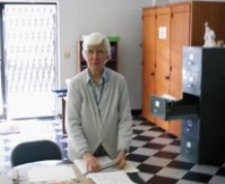
 Here is the National Geographic map of Antarctica which started our students' interest in the frozen continent. We used it as a part of our map reading/geography class. The other photo is of my desk area where we display the Antarctica map on the wall and have our Antarc
 tica Bullentin Board. I change the photos on the board whenever we get new images emailed to us from our pen pals in the United States Antarctica Program (USAP) at the South Pole Station -- Amundsen Scott Base. Our students get to see all the Antarctica photos sent to us in this way, and visitors to our school are amazed at the great photos from the South Pole Station. I took a photo of our bulletin board with the USAP photos on it and emailed it back to the South Pole. One of our friends there thought it was cool.
--- Adrian

Monday, June 9, 2008

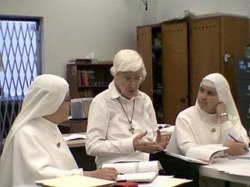
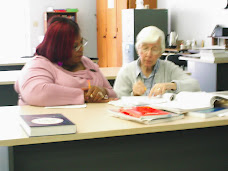
The news of the day is that Doretha Williams, to the left of Sr. Lory in the photo, has returned to class after an absence of several weeks. She is feeling better and ready to learn more and continue reading the works of one of her favorite authors, Dale Carnegie.
Joining Doretha and Sr. Lory in the photo is Jennie Gorden who had a short article of her own published this May in "AmeriWord," the newsletter for Literacy*AmeriCorps New Orleans. Her topic was from current events class concerning the earthquake in China and the cyclone in Myanmar (Burma).
Sunday, June 8, 2008
House-Keeping Note, Postings
Just as a point of information, all posts to this blog are made by the Blog Manager, Adrian McGrath, unless otherwise stated in the posted text. Thank you.
Antarctica Bulletin Board

Although the photo is a bit fuzzy, this is our Antarctica Bulletin Board at our school. It is a part of our Pen Pal Program with the United States Antarctica Program (USAP) wherein our students and teachers communicate with Americans living and working in Antarctica at the South Pole Station -- Amundsen-Scott Base. I helped organize this project a few months ago, and it has been a great source of learning for our students for many literacy skills from science to geography to writing skills. Our students communicate with our friends in the USAP via email. We hope to have much more information about this exciting program later.
By Adrian McGrath
Bayou St. John near SVDP-ALC

This is a photo of Bayou St. John near SVDP-ALC school; it is about a half of a mile away to the west. This is an old waterway which runs from Lake Ponchartrain to MidCity. In years past it was a waterway for commerce coming to the city which could not navigate going up the Mississippi River easily. Nowadays, it is blocked off from the lake near Robert E. Lee Blvd. near the lake and mainly serves as a popular attraction in the New Orleans neighborhoods called Gentilly and MidCity. Some people use small boats on the bayou, have picnics on the shore, or view the ducks, geese, and an occasional pelican nearby. SVDP-ALC is a part of Gentilly.
(Posted by Adrian McGrath)
Tuesday, May 20, 2008

(In photo: Sr. Lory Schaff, Lafayette Slocum, Jennie Gorden)
Proof that mathematics can be a fun and interesting school subject! Both Lafayette and Jennie are math students who have made excellent progress recently. Sr. Lory's main areas of teaching are math and science. (But the blog manager is more impressed with the fact that she has a masters degree from Notre Dame at South Bend and is, as a result, one of the "Fighting Irish"!)
Posted by Adrian
Monday, May 12, 2008
(Below is another example of student writing. The author is Kemoni Pollard who is a GED student from SVDP-ALC. She is writing on the topic of why people over eat nowadays. AM)
Why People Overeat
By Kemoni Pollard,
A Student at SVDP-ALC
Many people overeat these days. There are many reasons that may cause someone to overeat. Stress can cause someone to eat a lot. People overeat because of the following reasons: they have eating disorders, they might be bored, or they just want to pass time.
Stress is a big factor when it comes to eating.l Stress can cause people to overeat. It's not something you have control over. It's a feeling you have inside you such as being worried, sad, or depressed; and these emotions may trigger a nerve in your body that causes you to eat.
Many people also overeat because they have an eating disorder. It is also uncontrollable. People with eating disorders usually eat non-stop. They eat when they're not hungry because their minds are telling them to eat. That's why most of them are over weight
Some people just eat because they are bored. Now, I find that many people eat just to pass time. I find myself doing the exact same thing. When I am home and have nothing to do, I just eat unnecessary things just to keep myself occupied.
So, there are many reasons why people overeat these days. Some of them are controllable and some are not. For whatever reason, people should start thinking about their health instead of their stomachs.
Posted by Adrian
Why People Overeat
By Kemoni Pollard,
A Student at SVDP-ALC
Many people overeat these days. There are many reasons that may cause someone to overeat. Stress can cause someone to eat a lot. People overeat because of the following reasons: they have eating disorders, they might be bored, or they just want to pass time.
Stress is a big factor when it comes to eating.l Stress can cause people to overeat. It's not something you have control over. It's a feeling you have inside you such as being worried, sad, or depressed; and these emotions may trigger a nerve in your body that causes you to eat.
Many people also overeat because they have an eating disorder. It is also uncontrollable. People with eating disorders usually eat non-stop. They eat when they're not hungry because their minds are telling them to eat. That's why most of them are over weight
Some people just eat because they are bored. Now, I find that many people eat just to pass time. I find myself doing the exact same thing. When I am home and have nothing to do, I just eat unnecessary things just to keep myself occupied.
So, there are many reasons why people overeat these days. Some of them are controllable and some are not. For whatever reason, people should start thinking about their health instead of their stomachs.
Posted by Adrian
Thursday, May 1, 2008
Antarctica New Orleans Writing Project
The BIG NEWS is that we have started a new project at the SVDP-ALC school. We call it the Antarctica New Orleans Writing Project. As you can read in an earlier blog post, I conduct a small class at our school usually twice per week on map reading or geography. This has been a very good opportunity for our students to learn basic map reading skills and also learn about places all over the world, depending on the maps we use.
Some months ago we started to use a National Geographic map I have of Antarctica, and the students were quite interested in the subject. I decided to try to communicate with someone in Antarctica and perhaps have our students ask questions about life there so they could learn more about other lands. This would also be a way to open the door to other related subjects like math (to understand the distances, compute temperature changes, etc.), history (perhaps discuss exploration), and writing skills (I wanted the students to either write essays about this project or actually communicate with people in Antarctica).
One thing led to another and after many weeks I came into contact with a communications specialist with the United States Antarctica Program (USAP) which is affiliated with the National Science Foundation (NSF) which runs the programs for the USA at our three bases in Antarctica -- Palmer, McMurdo, and South Pole Station. I had the original idea for this project back around Christmas time 2007, and now after a few months exciting things are happening.
As of this week we are in direct contact via email with several people in the USAP who work at South Pole Station (actually at the South Pole!), and we expect to be in contact with McMurdo soon. McMurdo is the USA's sea base on the Ross Ice. I have gathered questions from our students for our new Antarctica pen pals, and we will post stories and Q&A right here at our blog and also on the newsletter, website, and blog for Literacy*AmeriCorps New Orleans. The newsletter for Literacy*AmeriCorps New Orleans is called AmeriWord.
So, join us here for exciting updates from Antarctica and New Orleans concerning the Antarctica New Orleans Writing Project.
Thanks, Adrian McGrath, Blog Manager
Some months ago we started to use a National Geographic map I have of Antarctica, and the students were quite interested in the subject. I decided to try to communicate with someone in Antarctica and perhaps have our students ask questions about life there so they could learn more about other lands. This would also be a way to open the door to other related subjects like math (to understand the distances, compute temperature changes, etc.), history (perhaps discuss exploration), and writing skills (I wanted the students to either write essays about this project or actually communicate with people in Antarctica).
One thing led to another and after many weeks I came into contact with a communications specialist with the United States Antarctica Program (USAP) which is affiliated with the National Science Foundation (NSF) which runs the programs for the USA at our three bases in Antarctica -- Palmer, McMurdo, and South Pole Station. I had the original idea for this project back around Christmas time 2007, and now after a few months exciting things are happening.
As of this week we are in direct contact via email with several people in the USAP who work at South Pole Station (actually at the South Pole!), and we expect to be in contact with McMurdo soon. McMurdo is the USA's sea base on the Ross Ice. I have gathered questions from our students for our new Antarctica pen pals, and we will post stories and Q&A right here at our blog and also on the newsletter, website, and blog for Literacy*AmeriCorps New Orleans. The newsletter for Literacy*AmeriCorps New Orleans is called AmeriWord.
So, join us here for exciting updates from Antarctica and New Orleans concerning the Antarctica New Orleans Writing Project.
Thanks, Adrian McGrath, Blog Manager
Wednesday, April 2, 2008
Student Writing
Blog Manager's Note: We hope to publish as often as possible writings done by our students here at SVDP-ALC. At present we are stressing essay writing. But in the near future we hope to have other types of writing too from poems and drama to short stories. The essay below is based on a book called Coming out the Door for the Ninth Ward which was affiliated with the program for the Literacy Alliance of New Orleans called "One Book One New Orleans." Wanda's essay below was originally published in "AmeriWord," the newsletter for Literacy*AmeriCorps in New Orleans, and is re-printed here with AmeriWord's permission.
Wanda is the first student from SVDP-ALC to have an article published in AmeriWord and on our SVDP-ALC blog. Congratulations, Wanda!
New Orleans Parading
By Wanda Miskell
(Wanda is a student at the St. Vincent de Paul Adult Learning Center in New Orleans, and her essay is based on the book Coming out the Door for the Ninth Ward.)
In New Orleans we have a culture of parading with Mardi Gras Indians, Second Lining, and "buck jumping." Buck jumping is a form of dancing with umbrellas and music. The people in Coming Out the Door for the Ninth Ward speak of different clubs and areas of town in which they grew up and became members of clubs such as the Seventh Ward High Steppers.
The club practices routines, and it was like spirituality to all the clubs because the slaves who came to New Orleans were allowed to dance in Congo Square. Today Congo Square is known as Armstrong Park, near the French Quarter.
A long time ago a Second Line was to celebrate the "home going" of a musician. Home going was the death of a person or the passing of a person. Nowadays, it's to celebrate life as well as death. Buck jumping was for people of a less fancy part of society. Buck jumping was a different term used from different wards. Second Lining was done only at certain times, mostly after the death of a musician.
Because of the different cultures and Mardi Gras, buck jumping and Second Lining were thought to be different. Yet although there is a difference in spirit, it is the same spirit of Louisiana. Dancing means free movement which symbolizes freedom from slavery. People of the Ninth, Seventh, Third, and other wards feel freedom and liberty when they second line, buck jump, and dance with the Indians.
Posted by Adrian
Wanda is the first student from SVDP-ALC to have an article published in AmeriWord and on our SVDP-ALC blog. Congratulations, Wanda!
New Orleans Parading
By Wanda Miskell
(Wanda is a student at the St. Vincent de Paul Adult Learning Center in New Orleans, and her essay is based on the book Coming out the Door for the Ninth Ward.)
In New Orleans we have a culture of parading with Mardi Gras Indians, Second Lining, and "buck jumping." Buck jumping is a form of dancing with umbrellas and music. The people in Coming Out the Door for the Ninth Ward speak of different clubs and areas of town in which they grew up and became members of clubs such as the Seventh Ward High Steppers.
The club practices routines, and it was like spirituality to all the clubs because the slaves who came to New Orleans were allowed to dance in Congo Square. Today Congo Square is known as Armstrong Park, near the French Quarter.
A long time ago a Second Line was to celebrate the "home going" of a musician. Home going was the death of a person or the passing of a person. Nowadays, it's to celebrate life as well as death. Buck jumping was for people of a less fancy part of society. Buck jumping was a different term used from different wards. Second Lining was done only at certain times, mostly after the death of a musician.
Because of the different cultures and Mardi Gras, buck jumping and Second Lining were thought to be different. Yet although there is a difference in spirit, it is the same spirit of Louisiana. Dancing means free movement which symbolizes freedom from slavery. People of the Ninth, Seventh, Third, and other wards feel freedom and liberty when they second line, buck jump, and dance with the Indians.
Posted by Adrian
Friday, March 14, 2008
A Poem for St. Patrick's Day
(Here's a nice poem from 1893 for us all to reflect upon for St. Patrick's Day, March 17th, 2008. Adrian)
Lake Isle of Innisfree
By William Butler Yates
I will arise and go now, and go to Innisfree,
And a small cabin build there, of clay and wattles made;
Nine bean-rows will I have there, a hive for the honey bee,
And live alone in the bee-loud glade.
And I shall have some peace there, for peace comes dropping slow
Dropping from the veils of the morning to where the cricket sings;
There midnight's all a glimmer, and noon a purple glow;
And evenings full of the linnet's wings.
I will arise and go now, for always night and day
I hear the lake water lapping with low sounds by the shore;
While I stand on the roadway, or on the pavements gray,
I hear it in the deep heart's core.
Lake Isle of Innisfree
By William Butler Yates
I will arise and go now, and go to Innisfree,
And a small cabin build there, of clay and wattles made;
Nine bean-rows will I have there, a hive for the honey bee,
And live alone in the bee-loud glade.
And I shall have some peace there, for peace comes dropping slow
Dropping from the veils of the morning to where the cricket sings;
There midnight's all a glimmer, and noon a purple glow;
And evenings full of the linnet's wings.
I will arise and go now, for always night and day
I hear the lake water lapping with low sounds by the shore;
While I stand on the roadway, or on the pavements gray,
I hear it in the deep heart's core.
Posted by Adrian McGrath
Friday, February 22, 2008
Learning with Maps
 (At left are students in our geography class here at SVDP-ALC, gathered around a map of the world.
On the wall above my desk, way in the back right corner of the room, is a map of Antarctica. Our students are learning all about that fascinating continent. Next to that is a poster about a "Second line" in the 9th Ward in New Orleans; a Second Line is a type of Jazz parade in New Orleans with music and dancing in the streets.
Below is an article I wrote for "AmeriWord," the newsletter of Literacy*AmeriCorps. It is about our regular geography class here at SVDP-ALC, and it is re-printed here with permission of "AmeriWord.")
Learning with Maps
By Adrian McGrath
Last month we began a new teaching session at our site at the St. Vincent de Paul Adult Learning Center in New Orleans which we call “map skills” or “map reading” class. Although initially the main focus of the session was basic geography, our class soon learned that many other subjects became involved and many opportunities arose for open class discussions during the sessions. And although the sessions were originally designed to have a lecture format, we soon found that they naturally evolved into interactive sessions with much student input that resulted in greater student interest. So, I thought it would be worthwhile to share with our readers some of the things we covered and what we learned and experienced.
I began with a plan to teach basic geography with four maps – a road map of the city of New Orleans, a map of the state of Louisiana, a United States map, and a world map. Beginning with the Louisiana map, I opened the map on a large flat table, gathered the students around the map, and began asking questions. “Where is New Orleans, where is Baton Rouge, where is Lafayette, where is Alexandria, where is Shreveport and Monroe?” I started with. The students looked at the map and began identifying the locations. Then I went to smaller towns in the state. “Where is Houma, where is Amite, and Grand Isle?” I asked. Again the students responded, this time with greater interest. Sometimes they would stand up from their chairs and start pointing to places on the map.
Then I explained how to use the various charts and tables along the sides of the map which help to locate towns and which explain the various symbols and colors on the map. These charts also help to measure distances between cities. So then this led to a whole new skill in map reading which was the mathematical measurement of distances. How far is New Orleans from Lafayette?” I asked. “Somebody please tell me.” The students responded with great interest, using the various charts to help locate the cities on the map grid (which has letters and number coordinates) and then using math skills to determine distances.
The session went very well, and I discovered that basically two maps could be covered well in a 45 minute session. So, I began by selecting the remainder of my four basic maps, but also used other maps which I had accumulated over the years from National Geographic (which somehow survived Hurricane Katrina) plus other maps which Sr. Lory Schaff, our site supervisor, donated to the cause.
When we came to the USA map and the world map, these naturally led to brief discussions of either current events or historical commentary. For example, one student had just read about Napoleon Bonaparte in an English grammar text. So, we were able to show where Napoleon had gone on his various campaigns from France to Russia to the Isle of St. Helena into exile.
The most extraordinary session occurred during the week before Martin Luther King, Jr. Day. We used a small booklet which described the life of Dr. King, and asked the students to read a passage out loud from the book. Whenever the name of a location, city, state, etc. was named, we briefly stopped and pointed on the USA map to where Dr. King was at the time. “Where is Atlanta, where is Birmingham, where is Montgomery, Washington DC?” I would ask. But now we would discuss not just where these places were but what happened there and why. The world map quickly came into play when we reached the part in the story where Dr. King was awarded the Nobel Peace Prize. “Where is Oslo, Norway?” ‘What happened there?” Finally, tragically, we had to discuss where Memphis was and what happened there too.
We also took a short time to have the students express their views on what Dr. King’s life meant to themselves and their country. So, all these learning experiences could arise from what was originally meant to be a simple geography class.
Many other leaning opportunities could come from map skills sessions as well, for example, students could be asked to write an essay about the places they have “visited” in map class. For instance, we looked at maps of the Middle East including Iraq and Afghanistan which are so much in the news. And the most exotic place we studied in our map class was the frozen continent of Antarctica. The students were fascinated by a lost world at the bottom of the globe which has extreme temperatures and appears to be almost from another world.
And our study of Antarctica led us to the actual study of other worlds as we examined briefly photos and diagrams of the planets in our solar system including Mars, Venus, Saturn and so forth. Antarctica and the other planets naturally gave way to a discussion of science.
So from starting with four basic maps, we went on to cover subjects such as math, science, history, political science, and many other topics.
I would very much recommend map skills sessions as a way to help students learn both geography and a host of other subjects too.
Posted by Adrian
Sunday, February 17, 2008
Plan for Weekly Updates
We hope in the future to update our blog at least once per week on Fridays, with more updates as needed. So stay tuned each weekend for an update.
This past Friday Sr. Lory and I attended a special training class at Delgado Community College here in New Orleans. It dealt with ABE (adult basic education) testing and was quite informative. This was done in conjunction with our Literacy*AmeriCorps New Orleans group. We learned a lot there and hope this will help us at our school.
At some future date I will explain my background a bit and tell how I came to be a teacher of ABE at SVDP-ALC. But for now, suffice to say, I am an AmeriCorps member and blog manager for this blog.
Other things of interest to our readers we hope to post in the near future will include 1. an overview of what we teach and why this is so important to our community, 2. a student writings section where we will post essays written by our students, 3. updates and information about our school, and 4. feeback and contributed essays from friends of SVDP-ALC.
And we will post more photos too if I can get my camera to work right.
Thanks and Happy Blogging,
Adrian McGrath, Blog Manager
This past Friday Sr. Lory and I attended a special training class at Delgado Community College here in New Orleans. It dealt with ABE (adult basic education) testing and was quite informative. This was done in conjunction with our Literacy*AmeriCorps New Orleans group. We learned a lot there and hope this will help us at our school.
At some future date I will explain my background a bit and tell how I came to be a teacher of ABE at SVDP-ALC. But for now, suffice to say, I am an AmeriCorps member and blog manager for this blog.
Other things of interest to our readers we hope to post in the near future will include 1. an overview of what we teach and why this is so important to our community, 2. a student writings section where we will post essays written by our students, 3. updates and information about our school, and 4. feeback and contributed essays from friends of SVDP-ALC.
And we will post more photos too if I can get my camera to work right.
Thanks and Happy Blogging,
Adrian McGrath, Blog Manager
Saturday, February 9, 2008
Photo of SVDP HQ and ALC (School) in Gentilly

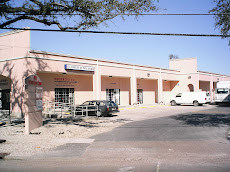
Here is a photo of the building where the St. Vincent de Paul Society (SVDP) has its headquarters here in the New Orleans neighborhood called Gentilly. The door to our school is to the right of the photo. (Most of this neighborhood was flooded during Hurricane Katrina.)
The St. Vincent de Paul Society, which works with the Catholic Archdiocese of New Orleans, has been helping the needy of this great city since 1852. (That's right, 1852!) SVDP has several other operations including a department store (or thrift store), a free pharmacy (staffed mainly by volunteers), and maintains the St. Vincent de Paul cemeteries in the Ninth Ward in old New Orleans. (Much of the Ninth Ward was devastated in Hurricane Katrina, as was seen world-wide on TV.) SVDP also maintains another cemetery for the poor located near St. Patrick's Cemetery Number One in New Orleans.
Our school (technically called the Adult Learning Center) is one of the latest additions to SVDP, and provides GED education and an ABE program. (GED edcation helps students get their high school equivalency diploma; and ABE -- adult basic education -- helps students increase their literacy skills in English language and mathematics mainly, but also in social studies and science.
SVDP-ALC was created after Hurricane Katrina devastated most of New Orleans, and it seeks to help adult learners in this struggling and recovering city improve their lives and their community through the benefits of education.
All of our classes are, of course, free of charge and open to the public.
Posted by Adrian
Thursday, February 7, 2008
Developing our site

Today we posted our contact information -- email, phone, and mailing address. Should you wish to contact us, please do so.
Also of note, we added some new links to our Links Section -- CJS sisters, Sr. Helen Prejean's blog, and the SVDP Society.
Also of note, we added some new links to our Links Section -- CJS sisters, Sr. Helen Prejean's blog, and the SVDP Society.
(The photo is of our school's sign painted on the front of the SVDP building here in the New Orleans neighborhood called Gentilly not far from City Park and Bayou St. John.)
Wednesday, February 6, 2008
Welcome to the blog for the St. Vincent de Paul Adult Learning Center in New Orleans, Louisiana!
(The official title for our school is St. Vincent de Paul Adult Learning Center for Empowerment, but it is often abbreviated as SVDP-ALC.)
We hope to bring our readers information about our school, its teachers, volunteers, and students as we work to improve the literacy skills of adult learners in post-Katrina New Orleans.
Thanks for dropping by our site.
(The official title for our school is St. Vincent de Paul Adult Learning Center for Empowerment, but it is often abbreviated as SVDP-ALC.)
We hope to bring our readers information about our school, its teachers, volunteers, and students as we work to improve the literacy skills of adult learners in post-Katrina New Orleans.
Thanks for dropping by our site.
Subscribe to:
Posts (Atom)