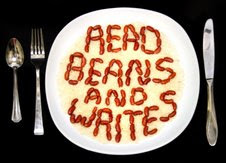
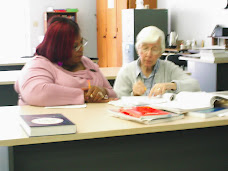
(In an effort to improve literacy skills, we at SVDP-ALC have decided to take advantage of one of the things Hurricane Katrina could not destroy -- our great food! So, we asked some of our students to write their recipes for great New Orleans dishes. Here is Sharon Kenney, a wonderful student at SVDP-ALC and her recipe for home-made New Orleans Red Beans and Rice. This is a very, very popular dish in the Crescent City; and it is traditionally served every Monday. Historically, Monday was wash day in New Orleans; and the beans would cook all day while the washing was done. Sharon's recipe jazzes up the dish with some extra flavors and spices.Saturday, August 9, 2008
Miss Sharon's Jazzy New Orleans Red Beans and Rice Recipe
(In an effort to improve literacy skills, we at SVDP-ALC have decided to take advantage of one of the things Hurricane Katrina could not destroy -- our great food! So, we asked some of our students to write their recipes for great New Orleans dishes. Here is Sharon Kenney, a wonderful student at SVDP-ALC and her recipe for home-made New Orleans Red Beans and Rice. This is a very, very popular dish in the Crescent City; and it is traditionally served every Monday. Historically, Monday was wash day in New Orleans; and the beans would cook all day while the washing was done. Sharon's recipe jazzes up the dish with some extra flavors and spices.Tuesday, August 5, 2008
Pop Quiz: Are these photos from Antarctica or New Orleans?


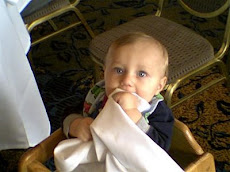
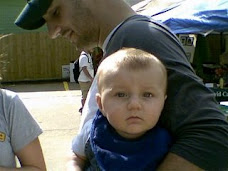
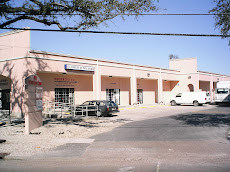
The Quiz Question is which of these photos come from Antarctica and which come from New Orleans?
The answer is that all come from the Amundsen-Scott South Pole Station in Antarctica EXCEPT the one photo of the street with the building with a "Spanish Lace" balcony. That one I took on Frenchmen Street in the Faubourg Marigny in New Orleans near the French Quarter.
Polies celebrate various days and events at the Pole like Mid Winter, the Sun Rise and Sun Set, and other key days much as we do with Mardi Gras, St. Patrick's and St. Joseph's days, the French Quarter Festival, Jazz Fest, and others.
Monday, August 4, 2008
Alenander Solzhenitsyn Died in Moscow Today

One of the greatest authors of our time has died -- Alexander Solzhenitsyn.
I first truly learned about this Nobel Prize winning writer when studying Russian literature at Loyola University in New Orleans with Professor Rochelle Ross (who was born in Russia, lived in Israel, became an American citizen, and taught at Loyola for many years). I was in many literature and language courses with Professor Ross, but two stand out in my mind: Justice in Russian Literature and Freedom in Russian Literature. Most of the skills I learned in language and literature, which I use today to teach my students at SVDP-ALC, I learned at Loyola from her. This included a study of the works of Solzhenitsyn.
Solzhenitsyn revealed to the world the terrible truth about the brutality of Communism, especially as it existed under Josef Stalin. Solzehnitsyn's book One Day in the Life of Ivan Denisovich brought him international acclaim not only as a great writer but as a moral thinker. Some have called him the conscience of Russia, and to a large extent, the conscience of the world. Like the character in his book, Solzhenitsyn himself was put into the Gulag (Soviet prison labor camp system) for being a political dissident.
Other works of his include The Gulag Archipelago, Cancer Ward, The First Circle, and others.
The SVDP-ALC blog takes note of this day in history, and in our geography class we will discuss this topic with our students further.
Solzhenitsyn once said: "Justice is conscience, not a personal conscience but the conscience of the whole of humanity. Those who clearly recognize the voice of their own conscience usually recognize also the voice of justice.”
May we all learn from his experiences and writings.
--Adrian
Sunday, August 3, 2008
The Moon at the South Pole, a John Miller photo

I took some good pictures of the moon, which was almost full, that had rays shooting out of four sides in the shape of a cross. The sight of this cross was absolutely awe inspiring; pictures do not do the sight justice. If you look closely you can see a very faint aurora in the picture as well."
Robert Burch, Ph. D. -- Guest Writer on Science
(We at SVDP-ALC are very happy to welcome our next guest writer, Robert Burch, Ph. D. If the name sounds familiar, that is because you read about his father at our blog at our July 19th post about World War 2. I first met Robert when we were students at Jesuit High in New Orleans, and we stayed in contact via mail and email over the years. He now lives up north with his wife Mary, who is also a Ph. D., and their children. He is still very interested in New Orleans and especially the state of education in post-Katrina New Orleans. He has been following our school's blog and has advised me many times on scientific aspects concerning our Antarctica project. After Jesuit, he went to college at Tulane University in New Orleans and then graduate school in chemistry at the University of California at Berkeley.I asked Robert the following question: Why should someone want to study science? This is the key question for our students. And here is his reply.
-- Adrian)
The Wonders of Science
By Robert Burch, Ph. D.
Do you ever wonder what makes things tick? For example, why do seeds sprout? What causes your heart to beat? What is a rainbow? Why are the days longer in the summer than the winter? All of us have a natural sense of curiosity about the world around us to one degree or another. That’s the stuff of science. It’s the study of the natural and physical world around us, so that we can make it understandable.
I remember a special moment I had early in school. It was in science class, and the teacher taught us about simple machines. There are six of them – pulleys, levers, wedges, incline planes, wheel & axle, and screw. The teacher showed us that examples are all around us, both in manmade machines and in the natural world. It was an Aha! moment for me, because of two things the teacher did. She showed us that complicated machinery is often nothing more than a careful assembly of lots of simple machines. This meant for me that complicated things could be understood in simple terms. Once again, it was the stuff of science.
I remember her teaching us about “mechanical advantage”, which was using basic arithmetic to figure out how much benefit these simple machines could provide in carrying out a job. For me, this was an inkling that science could be used to advantage in real life situations in ways that we could precisely define before even doing the job. It meant that science not only satisfied my curiosity but could be made useful to make people’s lives better. You can call that the practical application of science, or “technology”.
The practical application of science translates into all sorts of arts and crafts and trades we do in the adult world. It’s the basis for things. For instance, if you are a boat welder, how do you know what kind of material to use to weld the joint or what temperature? It comes from science. If you are a painter, how do you know what kind of paint to use for a certain job? It depends on using the right scientific formulation for the conditions the paint is exposed to. If you are a health care worker, how do you know when you’ve provided sanitary conditions for your patients? You use the scientific knowledge you have of how and where germs grow. As a consumer, how do you know what consumer information to believe? You apply the basic science you learned to the consumer product and how you intend to use it.
The sense of wonder and the practical application of science in everyday life, those are the reasons to study science. I made a career out of science, but you don’t have to make it a career to get a lot of benefit out of studying science.
(Thanks, Robert, for helping our students better understand the importance of science. Yes, a knowledge of science is especially important in the technological world of today; and, as our Antarctica project has shown, science can be fascinating and fun to learn too. -- Adrian)
Saturday, August 2, 2008
Remember Katrina: Miss Kitty, the Post-Katrina Cat

Wednesday, July 30, 2008
Student Sharon Kenney Discusses World War 2

Tuesday, July 29, 2008
The Dome at the South Pole Station
You can see why the electricians, like our pen pal John Miller, are so important as are the people responsible for the food supply, like Leah. It is not merely a matter of being comfortable, people's lives depend on these things and the people who work with these things. With the completion of the Elevated Station, seen in other photos on this blog, the dome is now a supply base; no one lives there now.
The inside of the dome is used to store food supplies and other necessities that can remain frozen. Thanks, Leah, for another great photo. You have opened our students' eyes to a whole new world! -- Adrian
Let There Be Light at the South Pole

Monday, July 28, 2008
The Pitot House on Bayou St. John
Here is another photo interlude from our regular series on Antarctica, Remember Katrina, WW2 Studies, and SVDP-ALC Updates. We do this from time to time so our blog readers and our Antarctica pen pals can get an idea of what some of New Orleans looks like (the part that was not destroyed by the storm).This is the Pitot House on Bayou St. John which dates from the early 1800's. It was the original home of the first mayor of New Orleans; now it is a small museum.
-- Adrian
Old U.S. Mint in the Vieux Carre'
Here is a brief interlude from our regular projects to view a scene from the Vieux Carre' in Old New Orleans. The Vieux Carre', the old quarter also known as The French Quarter, is the oldest part of New Orleans. There you will find some of the most interesting places in the U.S.A., maybe in the world. Here is a photo of the Old U.S. Mint which is now a museum. At present it is housing an exhibit on the treasures of Napoleon Bonaparte, who is, after all, a New Orleans favorite. Legend has it that the pirate Jean Lafitte had intended to rescue Napoleon from his imprisonment on the Isle of St. Helena and spirit him away from the hands of the British to ... where else.. the French Quarter in New Orleans. But Napoleon died on St. Helena before this could occur. His death mask is in the Cabildo, a museum near Jackson Square and the St. Louis Cathedral in the Quarter. There is a street named after Napoleon in New Orleans plus several streets on the streetcar line Uptown are named after famous Napoleonic battles. And since there is a French pastry named "the Napoleon," Bonaparte was bound to be popular in this city.-- Adrian
Sunday, July 27, 2008
Webcam Links for USAP, South Pole and McMurdo
http://www.usap.gov/videoClipsAndMaps/spwebcam.cfm
This is the link to the webcam for the Amundsen-Scott South Pole Station. Due to extreme weather conditions, the webcam is sometimes down; but there is still an amazing video at the link of the Aurora Australis, the Southern Lights. Be sure to click in and see this.
http://www.usap.gov/videoClipsAndMaps/mcmwebcam.cfm
And this is the webcam for McMurdo Station, the U.S. seabase in Antarctica. It is the largest "settlement" on the Ice.
Be sure to visit these links and the home site for www.usap.gov to read about the organization our Antarctica pen pals are with -- the United States Antarctic Program (USAP).
-- Adrian
Patti Muggivan, teacher, librarian -- Our First Guest Writer
Literacy and New Orleans
By Patti Muggivan
Every time I find myself in New Orleans proper, I am intrigued by its beauty and the easy-appearing nature of the city. But I have always been aware that that environment is deceiving. I think that New Orleans is riddled with crime and people living desperate lives. For me, literacy at all levels is essential for recovery [after the storm]. Literacy was important both pre-Katrina and post-Katrina. Reconstructing entire neighborhoods, with various demolitions and rebuildings, is very difficult. But so too is developing positive attitudes about teaching skills and learning skills. It must be done one person at a time. Improvements in law and government programs are also important.
I was watching the TV news the other day, and there was a story about Darfur and Sudan. I wanted to change the channel. It was so awful seeing a dying child. As I watched, a doctor being interviewed in the news story was saying, "When you ask Americans about the situation, they will say we didn't know. Two years from now they will say the same thing, and conditions will remain unchanged." But if there can be even a chance for Darfur and Sudan, then surely there must be a chance for New Orleans.
(Yes, that's quite a powerful comparison. And in both cases, the real issue, as the doctor implied, is neglect. By ignoring the problems -- both in Darfur and in New Orleans -- the problems only get worse. -- Adrian)
Saturday, July 26, 2008
Remember Hurricane Katrina, August 29th, 2005

Thursday, July 24, 2008
In the News: SVDP-ALC, USAP Pen Pals

Wednesday, July 23, 2008
Canal St. Streetcar in New Orleans

The Canal St. Streetcar, New Orleans

Monday, July 21, 2008
Jason McDonald on the Ice

Jason McDonald of the USAP sends us this cool photo of himself "on the ice." (In Antarctica, the expression "on the Ice" means being in Antarctica.) Double click the photo to enlarge to see how vaste the ice really is.
Jason has a lot in common with us in New Orleans. He was born in Baton Rouge -- must be an LSU Tigers fan -- and has even lived in New Orleans as have several members of his family. He understood the terrible events of Hurricane Katrina as well because of his connections to the Big Easy and Louisiana.
So, he can really understand the similarities and differences between us and the people "on the Ice." But though we live in different places, we have common dreams. Jason and the other Antarctica pen pals are really helping our students to learn a lot. It's a great education! Thanks for the emails and the great photo, Jason.
--Adrian
Sunday, July 20, 2008
Miss Doretha's World Famous New Orleans Gumbo Recipe !!

Saturday, July 19, 2008
Sharon Kenney Studying World War 2 History

Studying World War Two at SVDP-ALC

A frozen lake in Antarctica

Shandra Cordovano at a Frozen Lake Near McMurdo

Thursday, July 17, 2008
Sr. Kathleen Bahlinger has arrived at SVDP-ALC

Planet Mars, Antarctica, New Orleans

Wednesday, July 16, 2008
Mid-Winter, South Pole Station, Antarctica

Tuesday, July 15, 2008
Student Writing: "Myself and Antarctica" By Jennie Gorden

Sunday, July 13, 2008
Oiling Eggs at the Amundsen-Scott South Pole Station
+south+pole.jpg)
Calee Allen also sent us this amazing photo. What are the USAP members doing with the eggs at the South Pole? They are all in the station's galley putting oil on the eggs to preserve them. The oil makes an airtight coating which protects the eggs from the air which can make the eggs go bad. Eggs can last awhile, but eventually they become sour. There are no grocery stores around, of course; and the eggs must be preserved to last the long Antarctic "winter."
-- Adrian
Calee Allen at the New Station, South Pole
+calee+allen+south+pole.jpg)
Here is Calee Allen in front of the New Station (which is also called the Elevated Station) at the South Pole. She lives and works at the Amundsen-Scott base and has sent our school some spectacular photographs. Here is one of them. The Elevated Station is on stilts which can move the station up and down to compensate for the build-up of snow and ice which would otherwise block the entrance to the station. When the station is raised, the strong winds blow the snow away from under the station. Very ingenious. We could use some buildings that rise in New Orlease to avoid flooding, like in Katrina. --Adrian
Saturday, July 12, 2008
South Pole Electricians, John Miller, pen pal... and Satchmo
Images from the South Pole, Antarctica
--Adrian
Tuesday, July 8, 2008
South Pole Station -- John Miller, First Contact From Antarctica

Saturday, July 5, 2008
South Pole Amundsen Scott Station and Leah's Cake
Here are two more great photos sent to us from USAP member Leah Webster at the South Pole. The new Elevated Station is at left where our friends live. The amazing colors in the sky are the Aurora Australis. We can also see some other buildings in the photo and the Antarctic sun which sits low on the horizon.
At right is Leah Webster herself with the cake she baked. It looks just great, and our students call it a South Pole King Cake because it looks like the King Cakes we eat in New Orleans for Carnival Time. All Leah would really need to do to make this look like a New Orleans cake is to add sprinkled sugar on top in three colors -- purple, green, and gold which are the colors of the New Orleans Mardi Gras. But the students love the cake the way it is in the photo. It looks delicious!
From what we understand, baking cakes is very difficult at the Pole because of the high altitude and other extreme conditions.
This photo of Leah and her cake is one of the most popular photos with our students.
(People from New Orleans love to talk about food and cooking.)
Thanks, Leah, for the great photos!
-- Adrian
We Remember Hurricane Katrina

This is a satellite photo from the NASA website of Hurricane Katrina in late August, 2005. As you can see the storm takes up most of the Gulf of Mexico as it takes aim at the city of New Orleans and the Gulf Coast. Three years ago on August 29th, 2005, this monster hurricane smashed its way ashore with its eye about 25 miles east of New Orleans.
But it was almost a day later when the real horror began in New Orleans. The levees for the outfall, drainage canals -- the London Canal, the Industrial Canal, and the 17th Street Canal -- suddenly broke, and a tremendous flood occurred putting 80% of the city of New Orleans underwater. About 2,000 people died in Hurricane Katrina. The entire population of the city -- over 400,000 people -- were forced to evacuate, many to distant, unfamiliar cities and states. Some of them later died from illness, trauma, or other hardships; and many of the ones who survived still have not returned home. And all of them suffered either physically or emotionally.
Much of the city -- in neighborhoods like Gentilly, New Orleans East, Broadmoor, Lakeview, the Ninth Ward, and the Lower Ninth Ward -- is still, to this day, left in ruins. Houses remain destroyed and abandoned, and lives torn around and wrecked.
Hurricane Katrina was the worst disaster -- in terms of cost-- in American history.
All of the students, teachers, and volunteers at SVDP-ALC endured this nightmare, directly or indirectly. Hurricane Katrina is one reason why our school takes the topics of science and mathematics seriously; and why we are glad to have pen pals in the USAP in Antarctica who support, directly or indirectly, the study of weather conditions on our planet and the increasingly crucial study of climate change.
Our school blog will be having many more posts, and hopefully writings from our students, about the hurricane as we approach the third anniversary of that horrible day.
-- Adrian
Tuesday, July 1, 2008
South Pole Station and Aurora Australis
Sunday, June 29, 2008
End of June Update
During this breaktime, you might see our photos on our blog begin to look a bit differently from before. This is because I finally figured out how to use, somewhat, Photoshop and am trying to crop and edit some photos. Hopefully, they will look better. I will also attempt later on to add some Antarctica updates and some of the great photos which our school's pen pals at the USAP have sent us. All these things take time, of course. So, please stay tuned... Adrian
Saturday, June 14, 2008
Break Time
Adrian
Tuesday, June 10, 2008
Map of Antarctica
Here is the National Geographic map of Antarctica which started our students' interest in the frozen continent. We used it as a part of our map reading/geography class. The other photo is of my desk area where we display the Antarctica map on the wall and have our Antarc
tica Bullentin Board. I change the photos on the board whenever we get new images emailed to us from our pen pals in the United States Antarctica Program (USAP) at the South Pole Station -- Amundsen Scott Base. Our students get to see all the Antarctica photos sent to us in this way, and visitors to our school are amazed at the great photos from the South Pole Station. I took a photo of our bulletin board with the USAP photos on it and emailed it back to the South Pole. One of our friends there thought it was cool.Monday, June 9, 2008

Sunday, June 8, 2008
House-Keeping Note, Postings
Antarctica Bulletin Board

Bayou St. John near SVDP-ALC

Tuesday, May 20, 2008

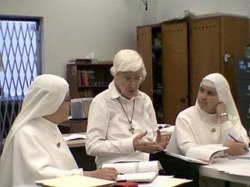
(In photo: Sr. Lory Schaff, Lafayette Slocum, Jennie Gorden)
Proof that mathematics can be a fun and interesting school subject! Both Lafayette and Jennie are math students who have made excellent progress recently. Sr. Lory's main areas of teaching are math and science. (But the blog manager is more impressed with the fact that she has a masters degree from Notre Dame at South Bend and is, as a result, one of the "Fighting Irish"!)
Posted by Adrian
Monday, May 12, 2008
Why People Overeat
By Kemoni Pollard,
A Student at SVDP-ALC
Many people overeat these days. There are many reasons that may cause someone to overeat. Stress can cause someone to eat a lot. People overeat because of the following reasons: they have eating disorders, they might be bored, or they just want to pass time.
Stress is a big factor when it comes to eating.l Stress can cause people to overeat. It's not something you have control over. It's a feeling you have inside you such as being worried, sad, or depressed; and these emotions may trigger a nerve in your body that causes you to eat.
Many people also overeat because they have an eating disorder. It is also uncontrollable. People with eating disorders usually eat non-stop. They eat when they're not hungry because their minds are telling them to eat. That's why most of them are over weight
Some people just eat because they are bored. Now, I find that many people eat just to pass time. I find myself doing the exact same thing. When I am home and have nothing to do, I just eat unnecessary things just to keep myself occupied.
So, there are many reasons why people overeat these days. Some of them are controllable and some are not. For whatever reason, people should start thinking about their health instead of their stomachs.
Posted by Adrian
Thursday, May 1, 2008
Antarctica New Orleans Writing Project
Some months ago we started to use a National Geographic map I have of Antarctica, and the students were quite interested in the subject. I decided to try to communicate with someone in Antarctica and perhaps have our students ask questions about life there so they could learn more about other lands. This would also be a way to open the door to other related subjects like math (to understand the distances, compute temperature changes, etc.), history (perhaps discuss exploration), and writing skills (I wanted the students to either write essays about this project or actually communicate with people in Antarctica).
One thing led to another and after many weeks I came into contact with a communications specialist with the United States Antarctica Program (USAP) which is affiliated with the National Science Foundation (NSF) which runs the programs for the USA at our three bases in Antarctica -- Palmer, McMurdo, and South Pole Station. I had the original idea for this project back around Christmas time 2007, and now after a few months exciting things are happening.
As of this week we are in direct contact via email with several people in the USAP who work at South Pole Station (actually at the South Pole!), and we expect to be in contact with McMurdo soon. McMurdo is the USA's sea base on the Ross Ice. I have gathered questions from our students for our new Antarctica pen pals, and we will post stories and Q&A right here at our blog and also on the newsletter, website, and blog for Literacy*AmeriCorps New Orleans. The newsletter for Literacy*AmeriCorps New Orleans is called AmeriWord.
So, join us here for exciting updates from Antarctica and New Orleans concerning the Antarctica New Orleans Writing Project.
Thanks, Adrian McGrath, Blog Manager
Wednesday, April 2, 2008
Student Writing
Wanda is the first student from SVDP-ALC to have an article published in AmeriWord and on our SVDP-ALC blog. Congratulations, Wanda!
New Orleans Parading
By Wanda Miskell
(Wanda is a student at the St. Vincent de Paul Adult Learning Center in New Orleans, and her essay is based on the book Coming out the Door for the Ninth Ward.)
In New Orleans we have a culture of parading with Mardi Gras Indians, Second Lining, and "buck jumping." Buck jumping is a form of dancing with umbrellas and music. The people in Coming Out the Door for the Ninth Ward speak of different clubs and areas of town in which they grew up and became members of clubs such as the Seventh Ward High Steppers.
The club practices routines, and it was like spirituality to all the clubs because the slaves who came to New Orleans were allowed to dance in Congo Square. Today Congo Square is known as Armstrong Park, near the French Quarter.
A long time ago a Second Line was to celebrate the "home going" of a musician. Home going was the death of a person or the passing of a person. Nowadays, it's to celebrate life as well as death. Buck jumping was for people of a less fancy part of society. Buck jumping was a different term used from different wards. Second Lining was done only at certain times, mostly after the death of a musician.
Because of the different cultures and Mardi Gras, buck jumping and Second Lining were thought to be different. Yet although there is a difference in spirit, it is the same spirit of Louisiana. Dancing means free movement which symbolizes freedom from slavery. People of the Ninth, Seventh, Third, and other wards feel freedom and liberty when they second line, buck jump, and dance with the Indians.
Posted by Adrian