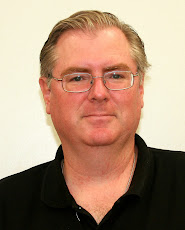
Since Adrian McGrath completed his two year stint as a Literacy AmeriCorps member, there have been no entries to this blog. Adrian was the creator, writer, and editor of the blog. His absence is greatly felt!
As a newly regrouped staff, we will continue to communicate with you through this medium - maybe not as colorfully or frequently as the previous writer!!
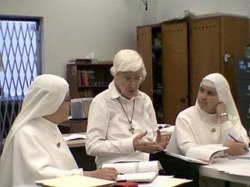
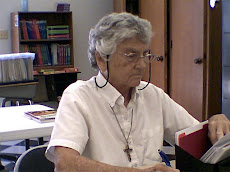
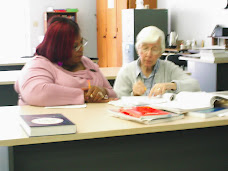
In early August, Sr. Bonita Sniegowski began teaching at SVdPALC. Sister came to New Orleans two years ago with three other members of her community to teach at St. Leo the Great Elementary School. Besides her experience as teacher and administrator in traditional Catholic schools, Sr. Bonita brings experience in adult education. Her quiet, affirming manner with our participants is an added gift to this program.
Becky Kleive is a member of our first St. Joseph Worker endeavor. This is a new ministry of the Congregation of St. Joseph, enabling four young college graduates to engage in some service to the community and experience community living.
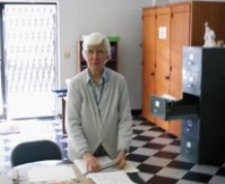
Becky graduated in May from St. Olaf College in Minnesota with a double major: Women's Studies and Environmental Studies. Her youthful enthusiasm and willing spirit are welcomed in this center.
Monday, October 19, 2009

Tuesday, August 18, 2009
My Final Blog Entry: Miss Kitty and the Parting Glass

(Read about the life story of Miss Kitty on this blog at this post:
If it does not click, then just copy and paste the link into the browswer. Miss Kitty's photo was taken by my sister, Marci.)
I can not list all of the people who have helped me over these past two years to "get things done." (That's our motto for Literacy AmeriCorps, by the way.) You know who you are, and you know that I appreciate GREATLY eveything that you have done to help.
Instead, as a symbol for US ALL who followed, wrote for, or read this blog (and you have helped us get 7816 hits on the blog since Feb. 2008 until today) -- the nuns, the students, our friends in Literacy AmeriCorps (in New Orleans and in Pittsburgh and elsewhere in the USA), at the Boggs Literacy Center and with the Literacy Alliance of Greater New Orleans, our friends who were at the Amundsen-Scott South Pole Station and McMurdo Station in Antarctica with the US Antarctic Program, my friends in Chatham, VA and in other states in the USA, my family and friends, and friends of SVDP-ALC, and me -- the story of Miss Kitty is a true tale of New Orleans.
She was a down-and-out alley cat from Bucktown (a part of Greater New Orleans), who was rescued by my sister Marci and her husband Chris. From there she went on to Chatham, VA where I became well acquainted with her in my Katrina Exile. She became the Queen of a Mardi Gras parade and the Princess of a St. Patrick's Day parade (just read her amazing cat story). She becamse a sort of folk-hero to the students at SVDP-ALC.
In fact, Doretha, one of our students, adored Miss Kitty so much that she asked for a print out of her photo to keep. She was writing an essay about Miss Kitty but had to leave school due to illness. But you can read about Doretha's gumbo receipe on this blog, which I emailed to the Amundsen-Scott South Pole Station, by the way. http://svdpalc.blogspot.com/2008/07/miss-dorethas-world-famous-new-orleans.html
Miss Kitty was certainly a fighter and never gave up until she was overwhelmed by a cat illness from old age.
So, really we can -- and we did-- learn from Miss Kitty. When ever I watch students scroll down on our school blog, they invariably stop and say, "Oh, look at the cat!" And then start reading.
So, Miss Kitty has became a force for literacy education, right here in Old New Orleans.
I will be leaving now. But you can always find me online at my new blog about New Orleans history at http://www.oldnolajournal.blogspot.com/ I plan to use this blog for many purposes among which is a tool for educating students about fundamental facts, and fun facts, about New Orleans. Also, simply reading it is a good way to practice literacy skills. And the stories may be used as prompts for student essay writing.
Finally, the Parting Glass.
At a traditional Irish music session or ceili, just before everyone leaves, one last song is played. This song is called The Parting Glass. So, here it is. For you all. Goodbye.
--Adrian
The Parting Glass
O, all the money that ere I spent,
I spent it in good company.
And all the harm that I ever did,
Alas, it was to none but me.
And all I've done from want of wit,
To memory now,
I can't recall.
So, fill to me the parting glass,
Good night,
And Joy be with you all...
Farewell Party and Red (Read) Beans and Rice (Writes)


Here are a few photos for the farewell party SVDP-ALC had for me. (Naturally, the nuns still taught school on that day as well as set aside some time for a party. I finished up some paperwork for AmeriCorps, as I recall.)
In the photo we see the poster of positive things the students did to improve their lives and their community since Hurricane Katrina. (Jennie and Ruby made the poster, but I took most of the photos ... And ALL of the photos came right from this blog, so you can scroll down and read all about these cool things we did over the past two years.)
Then we see a photo of Sr. Kathleen helping Sr. Silvia. We see a photo of lots of great foods. We had fried catfish, red beans and rice, bread pudding, real French bread, deviled eggs, little meatballs, and lots more, and soft drinks. The students and the nuns supplied all the goodies.
Then we see a photo of Sr. Lory next to a statue of St. Joseph. (Both Sr. Lory and Sr. Kathleen are with the Congregation of Sr. Joseph.)
Finally, we see Ruby and me. Ruby, as you recall from our blog, does lots of wonderful writing and portrayed Sojourner Truth in our International Women's Day event at SVDP-ALC. The other students gave me a farewell card with their comments about me on it (it was all good, yes! thank you), Jennie wrote a wonderful message, and spoke it at the party. (She also has public speaking experience with her many poems and essays published and her report on Sacagewea for Internationa Women's Day) ...
But what about that statue Ruby and I are holding which she gave me??
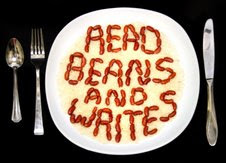
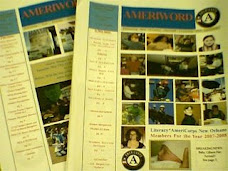
Well, that is a New Orleans chef with a cooked plate of red beans and rice. She gave it to me for the school in honor of my work with our new Literacy AmeriCorps student magazine called Read Beans and Writes which you can find online at www.literacygno.org , the website for Literacy AmeriCorps New Orleans and the Literacy Alliance of Greater New Orleans.
Wow! what a great award! Over the past many months our students at SVDP-ALC have cooked up a kitchen-full of essays, poems, short plays, and original food recipes to help fill both of our issues of Read Beans and Writes, together with student writers from the other adult education programs in New Orleans. Plus, many of our students had published writings in the student writing section of AmeriWord magazine, the newsletter for Literacy AmeriCorps, and of course for our blog -- which you are reading right now. Also, two of our students had essays published in the Change Agent magazine from Boston, Massachusetts about Hurricane Katrina. (In fact, Jennie had two essays published there.)
So, we did a lot of student writing at St. Vincent de Paul -- ALC over these past two years.
Thanks again, everyone
--Adrian
My Certificates, Time to Brag


Well, everyone, it has been a great two years! We got a lot of things done, So, now it is time to show off. (You will just have to indulge me for a few moments.)
So, here are copies of the wonderful certificates I have accumulated over the past two years with Literacy AmeriCorps New Orleans and with St. Vincent de Paul -- ALC.
In the photos we see the original certificate given to me from SVDP-ALC for the year 2007 -08 (signed by Sr. Lory herself!) and my AmeriCorps certificate for 2007-08.
Then we see my certificate of completion for Literacy AmeriCorps for 2008 -09, an Old NOLA Award given to me by Sarah for being the Corps historian (this is greatly appreciated !!), and a large, framed certificate from SVDP-ALC from Sr. Lory and Sr. Kathleen (which is wondeful ! and will go on display my bookshelf).
My thanks to everyone.
-- Adrian
Monday, August 17, 2009
Student Writing: Ruby Sterling
(Here is more student writing from our school. This time it deals with International Women's day.)
Sojourner Truth
By Ruby Sterling
In celebration of International Women’s Day, I am honored to present Sojouner Truth. This woman ... was a driven force that could not be extinguished, no matter the odds, with a deep-rooted love for all.
Sojouner Truth
Her given name was Isabella ‘Bamfree’ Hardenbergh born in Ulster County, New York about 1797 lived until 1883. Honesty, hard work, and prayer were engraved in her character. Her faith led her to become a preacher. She decided to change her name to Sojouner which means ‘to travel’ and Truth because to her this is what God’s gospel is. People came from miles around, different cities and states just to hear her message of hope. She worked along with abolitionist Frederick Douglas and Elizabeth Stanton. Even President Abraham Lincoln invited her to the White House. He presented a special book to her, even autographed it for her. It became one of her proudest moments in her time. She devoted the rest of her life to fighting for women’s rights.
Sojourner Truth
By Ruby Sterling
In celebration of International Women’s Day, I am honored to present Sojouner Truth. This woman ... was a driven force that could not be extinguished, no matter the odds, with a deep-rooted love for all.
Sojouner Truth
Her given name was Isabella ‘Bamfree’ Hardenbergh born in Ulster County, New York about 1797 lived until 1883. Honesty, hard work, and prayer were engraved in her character. Her faith led her to become a preacher. She decided to change her name to Sojouner which means ‘to travel’ and Truth because to her this is what God’s gospel is. People came from miles around, different cities and states just to hear her message of hope. She worked along with abolitionist Frederick Douglas and Elizabeth Stanton. Even President Abraham Lincoln invited her to the White House. He presented a special book to her, even autographed it for her. It became one of her proudest moments in her time. She devoted the rest of her life to fighting for women’s rights.
Still Watching for Tropical Storm Ana

Well, we are feeling a bit better today after learning that the Tropical Storm Ana might not be coming our way. But, stay tuned and watch the reports at www.nhc.noaa.gov. Thanks!
Sunday, August 16, 2009
Tropical Storm Ana: My "Peaceful" Farewell

Well, folks, I had hoped to have a peaceful and reflective farewell to the SVDP-ALC blog as I finish my role as blog manager on this Tuesday.
BUT ...
This is New Orleans. So, now we have a new tropical storm and soon-to-be hurricane to deal with. It is Ana. As you can see from the NOAA chart, it looks like we will be soon in the "cone of uncertainty."
Somehow since Katrina, I have always felt like I lived in the "cone of uncertainty." Of that, yes, I am certain -- certain uncertainty.
What will happen now? Who knows? You can keep an eye on the storm by going to www.nhc.noaa.gov and check for Ana. (Maybe our friends in McMurdo, Antarctica are watching this now via satellite?)
What a way to finish up my two years of post-Katrina Literacy AmeriCorps! Last year was Hurricane Gustav and Ike, and now comes Ana. Sometimes I just don't know what to say anymore...
--Adrian
Thursday, August 13, 2009
"The Long and Winding Road" Nears Its End


Well, folks, it's almost over now -- my two years of Literacy AmeriCorps at St. Vincent de Paul - ALC are almost done. I am happy to have done this, and sad that it will all be over soon. I will be posting my stories until Tuesday the 18th of August. Then, that's it. I will only write for this blog as a guest writer after that.
George Harrison said it best: "All things must pass. None of life's strings can last. So, I must be on my way and face another day."
Above are photos -- taken by Sr. Lory herself! -- of my bicycle and me with my bicycle. I have driven this wonderful piece of eco-technology now for two years from Lakeview, through City Park, across Bayou St. John, down De Saix Blvd., and into Gentilly to our school. Yes, it was the long and winding road.
The coldest day I rode my bike was in January of 2008; it was 19 degrees F with a windchill much lower. I actually saw ice on the side of the street in New Orleans near Tad Gormley Stadium in City Park. The hottest days were in June of this year with many weeks of extreme heat -- especially when I was on special assignment to Incarnate Word Catholic Charities in Carrollton. Then the temperatures were well over 100 degrees F.
I prefer the cold, even 19 degress, to the heat.
We did a lot of great things this year, and we did a lot of wonderful things last year too.
Thank you for following this blog. Please continue to do so in the future.
-- Adrian
Wednesday, August 12, 2009
SVDP-ALC Welcomes Our 2 New Teachers!
We now have two new teachers at SVDP-ALC -- Sr. Bonita and Becky. You will be hearing much more about them and from them on this blog soon. Our Literacy AmeriCorps member, Adrian, will be ending his second and final year of service at SVDP-ALC and with AmeriCorps. (Only two one year terms are allowed with Literacy AmeriCorps under their rules.) It has been a great two years, and we will let you know more about Adrian's next steps as time goes by. So, stay tuned to this blog.
Thank you for continuing to follow our blog!
Thank you for continuing to follow our blog!
Sunday, August 9, 2009
Antarctica History: Roald Amundsen


To help our students and blog readers better understand our pen pal program with the USAP, I have written a few short articles on Antarctic explorers. One of the most important explorers was Roald Amundsen from Norway, who explored both the North and South Poles. He used a very precise, even scientific, approach towards exploration. Nothing was left to chance; everything was carefully planned.
His greatest achievement was being the first human being to reach the South Pole, along with his crew. With a team of four men, 52 dogs, and four sleds, Amundsen reached the South Pole in December of 1911. As proof that he achieved this, he left a small tent and a Norwegian flag and a hand-written note. Several weeks later, the British crew under Robert Falcon Scott found the tent. Amundsen's tent is depicted in the picture above which was sent to us by our pen pal in the USAP, John Miller, via email. The painting was done to commerate the 60th anniversay of the discovery by Amundsen. It was donated to the Americans at the Amundsen-Scott South Pole Station by Finn Ronne, the explorer and husband of Erika Ronne, who was the first American woman on an Antarctic expedition. See the story below about Erika.
Our USAP pen pal John Miller spent a night in a replica of this Amundsen tent, which Scott also used when he reached the Pole. We held a student writing contest about this several months ago, and it is described on this blog, scroll down.
Roald Amundsen died mysteriously while flying in an airplane on a rescue mission near the Arctic (not Antarctic). His plane went down and was never found.
(One photo is of Amundsen on a sea voyage to the Arctic. The painting is of Amundsen at the South Pole sent to us from John Miller, USAP. The Amundsen ship photo is in public domain from Wikimedia Commons. The painting is courtesy of our friends at the USAP. The other photo was sent to me by John Miller, USAP. It is of Amundsen and his crew near their tent at the South Pole in 1911. It is the basis for the commemorative painting.)
-- Adrian
Antarctica History: Ernest Shackleton


To help our students and blog readers better appreciate our pen pal program with the US Antarctic Program, which has been going on now for two years, I am adding a few stories about the history of Antarctic exploration. The following story is about my favorite Antarctic explorer -- other than our present pen pals, of course-- whose name is Ernest Shackleton.
Shackleton was born in county Kildare, Ireland and became a sailor. He was a junior member of an early expedition by Robert Falcon Scott, but he longed to lead his own expedition to the South Pole. After the Norwegian Roald Amundsen and his crew became the first men to reach the Pole, followed by Scott and his crew who all later perished on the return trek, Shackleton knew he needed a different challenge. After giving many lecture tours about his earlier expedition to Antarctica, he decided to become the first to lead an expedition across the entire continent. This became the expic adventure of the ship Endurance.
The plan was to have half of his men come from one side of Antarctica on the Weddell Sea, and the other half from the other side on the Ross Sea. Then they would set supply depots as they moved and crossed Antarctica.
However, Shackleton's ship, the Endurance, became trapped in the ice in the Weddell Sea and was crushed. Shakleton had to lead his men and some sled dogs, and whatever salvaged supplies he had, to safety. Against incredible odds, in extreme cold, in the open Antarctic wilderness, and with very little food and supplies, Shackleton managed to save his crew. Part of his adventures included sailing in a lifeboat called the James Caird with part of his crew across frozen seas from Elephant Island to South Georgia Island, getting help, and then going back to save the rest of his crew who stayed behind. Shackleton did not lose a single man in his crew. His greatness was that even though his original goal -- to cross Antarctica -- was a total failure, he found a new and far more meaningful goal, that of saving the lives of his crew.
(Photos: The boat is the James Caird, a life boat from the Endurance which Shackleton used in his attempt to save his crew. The photo was taken by the ship's photographer, Frank Hurley. The poster is a copy of an advertisement for a lecture tour of Shackleton's before his Endurance Expedition. The map is of Antarctica from the US Government, CIA maps. All of the photos are in public domain from Wikimedia Commons. )
-- Adrian
Antarctica History: Robert Falcon Scott


(Note: In order to better appreciate our pen pal program with the US Antarctic Program, I am writing a few stories about the history of Antarctic exploration. )
Robert Falcon Scott is one of the most famous names associated with Antarctica. He was a British naval officer who led two expeditions to the continent. His most famous undertaking, however, ended in tragedy. His sad tale occurred on the second expedition in 1911-12 (see map) called the Terra Nova Expedition.
He and a party of five reached the South Pole only to discover that the Norwegians under Roald Amundsen had just recently reached there as well, making the Norwegians the first men to reach the South Pole. On his return back from the Pole, Scott's team ran into extreme difficulties with the cold weather and with a lack of food. Scott and his men died in Antarctica on this return trip from starvation and extreme cold, and their remains were later discoverd by a search team several months later.
Scott, however, became a legendary and romantic figure in Britain because of his Terra Nova Expedition and his tragic death.
(In the photos we see Scott in his hut near what is now the US base called McMurdo Station. We see Scott (2nd from the right) and his crew at the South Pole. And we see a map of the expedition. All of the photos are from Wikimedia Commons and in public domain.)
--Adrian
Antarctica History: Edith Ronne
 Here is a significant story to consider in light of our pen pal program with Antarctica through the US Antarctic Program. In June of this year Edith Ronne died at the age of 89. She was sometimes referred to as "Antarctica's First Lady." Edith was the first American woman to ever be an active part of a US Antarctic expedition. This occurred during the 1940's. She was the wife of Finn Ronne, a famous explorer. (The first woman from any country to travel to Antarctica -- that we know of -- was Caroline Mikkelson, a Norwegian, who went there in 1935.)
Edith's main task was the provide a written historical narrative of the expedition; she had a history degree from George Washington University.
The Ronne Ice Shelf -- which is on the direct opposite side of the continent from the Ross Ice Shelf where our USAP pen pal is-- was named after her by her husband, Finn.
In the photo above --taken by the US Navy and in public domain -- we see her carrying a sign at the South Pole in 1971. "SWG" stands for Society of Women Geographers. She and a Canadian woman named Jennie Darlington were the first women to "winter-over" in Antarctica in 1947-48. "Winter-over's" are people who stay in Antarctica during their "winter," which is our summer.
--Adrian
Saturday, August 8, 2009
Studying World War 2: Ira Hayes, USMC
+Joe+Rosenthal.jpg)


For our final story this year in our series at SVDP-ALC called "Studying World War ll," we will take note of the life and tragic death of a heroic US Marine named Ira Hayes. He was one of the men who fought their way up Mt. Suribachi on Iwo Jima and raised the American flag there. This brought him international fame. But Ira Hayes never wanted that fame. Instead, he always remembered his friends and comrades in the Marine Corps who died on Iwo Jima. Over 5000 US Marines died there -- the greatest loss of Marines in any battle in their history. But the Marines took Iwo Jima and killed or captured all of the 20,000 Japanese combatants on the island. After the photo of the flag raising made him and four other Marines and a US Navy Corpsman famous, Ira met President Truman and even appeared briefly (as himself) in the John Wayne film "The Sands of Iwo Jima."
Ira Hayes participated in these public appearances mainly to help sell war bonds or to benefit the US government and military, but always he felt severe emotional pain over what he experienced in the war and the loss of his friends in combat.
After the war Corporal Ira Hayes suffered from alcoholism and PTSD (post traumatic stress disorder) or what was then called "battle fatigue." He was arrested many times for public drunkenness. Because he was a Native American (Pima), many bigots made racial slurs against him. (Incidently, many American Indians served proudly and honorably in the US Marine Corps in WW2, some as "code talkers" speaking in their native Indian language to fool the Japanese.)
Ira Hayes never adjusted well to life after the war and died as a result of alcoholism and PTSD. One day he was discovered face down in a muddy ditch on a farm near his home on the Gila River Indian Reservation in Arizona. Allegedly, he had been drinking heavily the night before and collapsed and died of exposure to the outdoor elements. He was 32 years old.
Ira Hayes -- like the other Marines he served with -- were true American heroes and deserve the admiration of our country. Ira's story is so tragic but important too. It teaches us about the problems of PTSD and the mental harm war and other traumas (like hurricanes) can cause. It shows us that alcoholism is a disease which requires proper medical treatment. And lastly, it shows us how evil and unjust prejudice is -- when even a true American hero could be shunned and insulted, despite his profound patriotist and self-sacrifice, simply because he was an American Indian or Native American. We should always remember this proud Marine when we study World War ll. Ira Hayes was buried at Arlington National Cemetery.
(The photos are in the public domain from Wikimedia Commons of Iwo Jima and Ira Hayes in his USMC uniform. The photo of the flag raising on Mt. Suribachi is, of course, the famous photo by Joe Rosenthal which is used here under the "Fair Use" doctrine for educational and non-profit purposes -- from Wikipedia.com. In Rosenthal's photo, Ira Hayes is the Marine at the far left.)
--Adrian
Tuesday, July 28, 2009
Our Small Group Class -- A Discussion about Writing
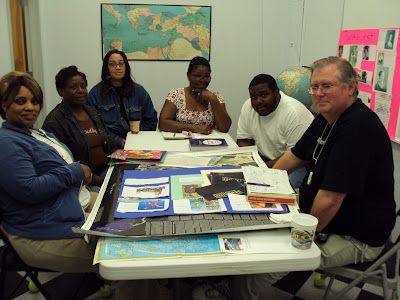
Here is a photo Sr. Kathleen took of our small group class. In this session we were discussing the topic of writing. We were reviewing our recent publication of the student magazine Read Beans and Writes and talking about what new essays, short plays, or poems the students would write.
Although one-on-one tutoring is the bulk of our ABE/GED/ESL teaching, small group classes are a very good way to develop student interest and exchange ideas.
In the photo from left to right are Valerie, Jennie, Eliria, Ruby, Roderick, and me (Adrian).
--Adrian
Saturday, July 25, 2009
Antarctic Photography - John Miller at McMurdo


Our pen pal at McMurdo Station in Antarctica, John Miller, sent us these two spectacular photographs he took recently near the Pegasus airfield near McMurdo. The top photo shows the strange orange sky in Antarctica. John pointed out that he had never seen a sky so orange anywhere else on Earth.
The next photo is of Mount Erebus, a volcanic mountain near McMurdo Station. We can see the lights of McMurdo in the foreground. McMurdo is a small "town" -- really a collection of USAP huts and buildings -- on Ross Island on the Ross Ice Shelf. The station houses the scientists and support staff who live in Antarctica. McMurdo is also the chief source of supply for the Amundsen-Scott South Pole Station, about 800 miles inland. John was at South Pole last year, and you can read about that experience elsewhere on this blog.
-- Adrian
Tuesday, July 14, 2009
A Letter From Billy Edwards, SVDP-ALC Volunteer Teacher


Our good friend and volunteer teacher at SVDP-ALC, Billy Edwards of Tau House in New Orleans, is at his family's farm up north for the summer. He sent us an email with photos about his life, and it reveals that philosophy and spirituality can exist even while doing farm chores.
Below are some thoughts from Billy. Thanks for the words and photos, Billy.
Billy operates a spiritual center in New Orleans called Tau House. See www.tauhouseneworleans.blogspot.com/
"I was able to take the attached photo of me just when I had finished bailing hay this past week. Making hay is some of the hardest work we do here. But, for me at least, it is among the most rewarding. When I'm riding the tractor up and down all those rows I find myself thinking of, and praying for, many of the people I know including everyone at the adult learning center. You wouldn't ordinarily think of time on the tractor as prayer time but it is for me. I'm always amazed how God made all this stuff around me, and how the sun, the earth, water, soil, combine, react, grow, to produce the things we really need. Farming is the one industry without which none of the others could exist. Who cares if you can build a computer if you have nothing to eat?
My dogs sometime ride in the cab of the tractor with me - one of the pictures shows them (I hope it's not too dark). We raise Belgian Draft Horses. They're big like Clydesdales, twice the size of an average horse.
My dogs sometime ride in the cab of the tractor with me - one of the pictures shows them (I hope it's not too dark). We raise Belgian Draft Horses. They're big like Clydesdales, twice the size of an average horse.
Billy
Monday, July 13, 2009
Our New GED Graduate -- Carlen Foster

Here's some great news !
We just found out that our student Carlen Foster just passed his GED exams, so he will now receive his high school equivalency diploma, signed and sealed by the state of Louisiana.
This is really wonderful. Here he is in the photo with Sr. Lory (left) and Sr. Kathleen.
As you may recall Carlen wrote a very moving essay recently for our blog about his belief in Jesus.
Carlen visited our school today and he will be a part of the GED graduation ceremony which (we expect) will occur at Loyola next Spring. Congratulations!
Adrian
(Below is a re-printing of Carlen's article.)
By Carlen M. Foster
Being raised by my grandmother, she tried her hardest to instill in me the importance of knowing Jesus Christ. I never understood why she would force me to join her church every Sunday morning. Also, I didn't believe that having a relationship with Jesus was as important as it is. As I grew older there were a number of situations that took place in my life which made me realize how wrong I was.
In October of 2007, I was indicted on a number of federal drug charges. I was facing up to five years in prison for these offenses. I began attending church every Sunday while out on bond. One year after being arrested, I joined the church I was attending and decided to be baptized again. I had received my date on which I was to be sentenced for the charges I was accused of. It just so happened to fall on my birthday. At that point, I began to pray and ask Jesus to bring me through my tough times and asked that I receive a sentence with no prison time included.
Well, my prayers were answered; and my faith grew stronger.
On December 14, 2008, I gave my life to Jesus. I was baptized and was determined to never lose sight of the One who was there for me when ever I called on Him. That very night I was involved in a home invasion in which my family and a close friend of mine life was in danger.
I called on Jesus and once again, He showed His power.
I have only Jesus to thank for not only myself still being alive today but also my family and close friend as well.
It took me a long time to know and understand why my grandmother would force me to church on Sunday as an adolescent, but I now have the answer and the understanding.
Thursday, July 9, 2009
Flower Power, Part 2


Brought to you by popular demand are more photos of Sr. Kathleen's flower garden. People are really interested in this story of this flower garden. So, here are some close-ups of the flowers and photos with the students and the nuns.
--Adrian
Monday, July 6, 2009
Flower Power! Sr. Kathleen's Garden


Well, we just returned from summer break and, low and behold, Sr. Kathleen's garden has grown. We now have real flowers!
I think they are called zinnias, but I'm not sure.
If you like the garden, send us your comments.
The weather has been terribly hot and dry in New Orleans for the past few weeks, so this has been a problem. But today it rained and cooled off a bit.
So, let's hope that the flowers like the change of weather. (Note: In the photo above we see Sr. Kathleen and her flowers.)
--Adrian
Wednesday, July 1, 2009
Life at McMurdo, Antarctica -- John Miller, USAP


Here are more photos recently sent to us from our pen pal, John Miller, who is with the US Antarctic Program at McMurdo Station. In the top two photos, we see John (in the red hat) attending a trauma simulation. In these trainings USAP members learn various aspects of First Aid as it applies to the dangers of Antarctica. In the next photo we see John in the freezing weather working on the hot water line. (John's expertise is electricity, and you can just imagine how essential that is in the extreme weather there.)
In the final photos we see an "A Frame" house that is (was) near McMurdo Station. It recently had a fire, and you can see what happened. Fire is a very serious problem in Antarctica. USAP members provide their own volunteer fire department and their own emergency rescue teams from themselves.
Antarctica is a dangerous place.
-- Adrian
Subscribe to:
Posts (Atom)